Compiled AI Agent Execution
Why MightyBot
Compiled AI agent execution is the architecture MightyBot uses for regulated workflows where sequential prompt chains are too slow and too hard to audit. MightyBot maps the full goal, identifies dependencies, and runs independent steps in parallel, with recursion built in and 99%+ accuracy in the flagship production lending deployment.
Where AI Spend Goes When Agents Loop
Most AI agent platforms reason about the next step, take one action, observe the result, and repeat. For financial services workflows with dozens of documents and complex policy evaluations, sequential execution is a dead end. Slow. Inefficient. Inaccurate.
The problem is not the model. The problem is the architecture.
How Compiled AI Agent Execution Works
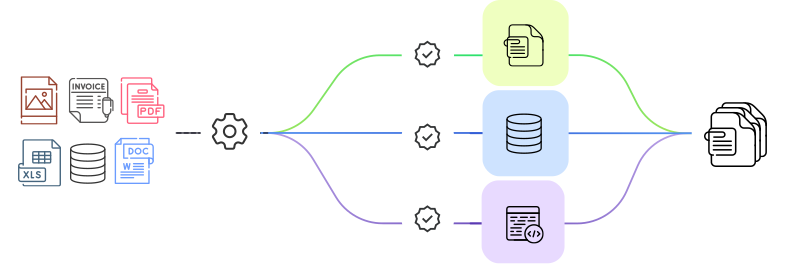
MightyBot does not chain prompts. It compiles execution plans.
The system analyzes the full goal, maps dependencies, and compiles a structured execution plan. Steps without dependencies run in parallel. Same inputs, same execution path. Every time.
The difference is measured, not claimed. A July 2026 study that ran the same multi-document workload in both styles on live models found growing-context agents replay 3.6x the input tokens of a single structured pass, at 3.5x the cost per evaluation cycle.
Not faster prompts. Fundamentally better architecture.
Measured: sequential vs compiled execution (July 2026 study)
The July 2026 agent evaluation cost study measured the same multi-document workload across these execution configurations.
| Configuration | Tokens per cycle | Cost per cycle (uncached) | Cost per cycle (cached) | Study observation |
|---|---|---|---|---|
| Single-pass evaluation (12 viewpoints) | 297.9K in / 30.0K out | $1.34 | $0.64 | Outputs hit token caps; misses leave no recorded reason |
| Agentic evaluation (4-turn agents x12) | 1.074M in / 94.8K out | $4.64 | $1.85 | 3.6x input replay measured; single-run flip rate ~20% on borderline decisions |
| Parity attempt (2-3 voting passes + verification) | ~2.4M to 3.5M total | $10.63 - $15.27 | $4.35 - $6.20 | Error floors near 10.4% at 3 votes; tens of minutes per cycle; no audit trail |
Where the Plan Comes From
Workflows are not drawn on a canvas. The Agent Compiler analyzes the goal, the documents, and the policies that govern the work, then emits the plan: schemas, steps, dependencies, and validation.
Execution style matches the work. A compiled plan for structured workflows, stepwise reasoning where judgment is needed, planned sequences for long-running processes. The point is not which model is used. It is whether the task benefits from parallel execution, step-by-step reasoning, or a planned sequence.
Describe the work. The platform compiles the agent.
The Multi-Agent System
Specialized agents handle distinct responsibilities. Each one built for its job.
-
Gatekeeper Agent
Validates inputs before processing begins. Checks document completeness, data quality, threshold conditions. Bad data stops here.
-
Builder Agent
Executes the core workflow: document processing, extraction, policy evaluation, decision assembly. Follows the compiled plan.
-
Reconciliation Agent
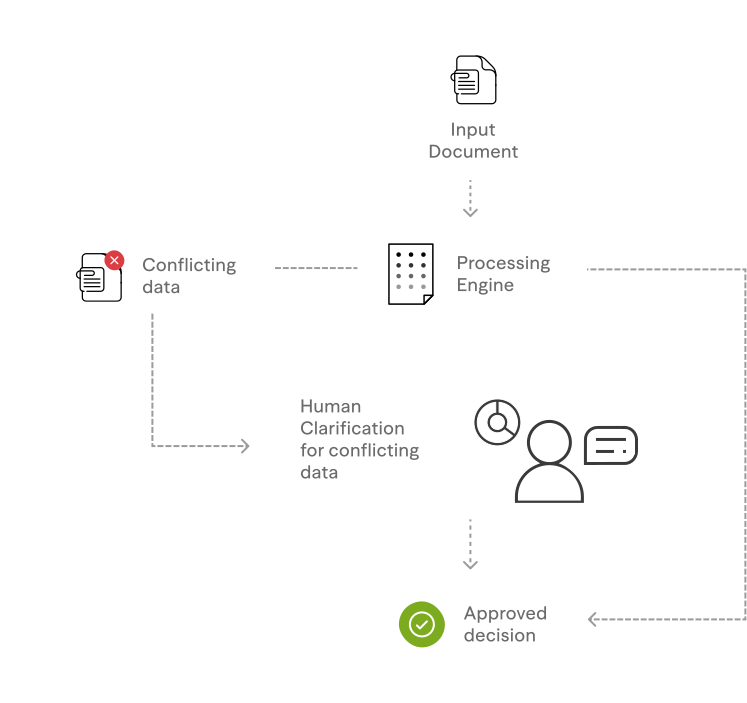
Resolves conflicts when data from multiple sources disagrees. Flags unresolvable conflicts for human review.
-
Verification Agent
Verifies extracted values match source documents and evaluations are consistent. Catches errors before they propagate.

Four agents. One compiled plan. Every step verified.
Edge Cases Handled
The gap between demo and production is measured in edge cases.
When the Gatekeeper cannot classify a document, it routes to human review. When the Reconciliation Agent finds a discrepancy, it escalates with both values, both sources, and the relevant threshold. Resolved in seconds.
This is how MightyBot reaches 99%+ accuracy in the flagship production lending deployment: by catching errors before they become decisions.
Stateful Process Management
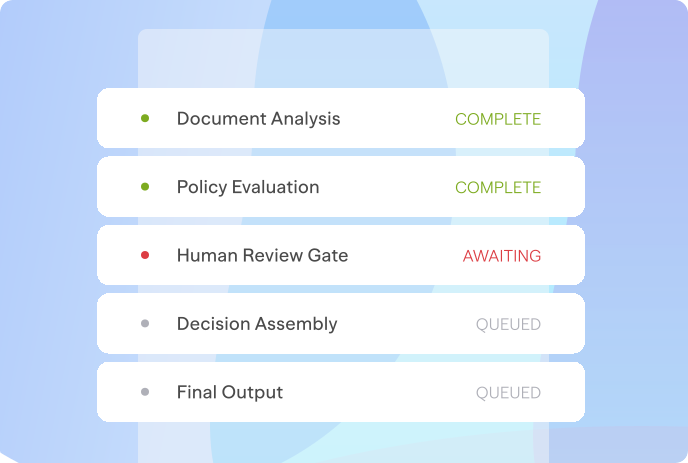
Financial services workflows run for days. MightyBot maintains full process state. Agents pause mid-workflow for a human reviewer or additional document. When the blocking condition resolves, execution resumes where it left off. No reprocessing.
See compiled execution on your workflows.
Explore the stack
The rest of the Decision Execution Stack.
Which use case fits you
Start with the workflow that pays back first.
These are the workflows MightyBot runs in production today, each with a buyer's guide, regulator references and the evidence trail examiners ask for.
FAQ
Frequently Asked Questions
What is compiled AI agent execution?
Compiled AI agent execution means the system analyzes the full goal, maps dependencies, and creates an execution plan before work begins. MightyBot then runs independent steps in parallel instead of looping through one prompt at a time.
What is parallel AI agent execution?
Running independent steps of a compiled plan at the same time instead of in sequence. Because the plan is known before execution, the runtime can fan out document reads, extractions, and checks safely, then join for the policy decision: lower latency without losing determinism.
What makes an AI agent token efficient?
Not re-deriving the plan on every run. Compiled execution plans once and executes deterministically, avoiding repeated context reloading and reasoning loops; in the July 2026 measured study that difference was 10x on the same workload.
How do the specialized agents coordinate?
Through the compiled plan. Gatekeeper validates before Builder processes. Builder feeds the Verification Agent. Reconciliation resolves conflicts. All coordination follows the dependency graph.
What happens when an agent encounters an unexpected situation?
Defined escalation paths. Low-confidence classifications route to human review. Data conflicts escalate with full context. The system never guesses on material decisions.
Does parallel execution work with real-time integrations?
Yes. API calls to your LOS, CRM, or third-party services run in parallel where possible. Dependent steps queue until prerequisites complete.
How does MightyBot ensure consistency in parallel?
The plan maps dependencies explicitly. Parallel execution only occurs between independent operations. The Verification Agent validates before final output.
Which AI model does MightyBot use?
The platform is model-neutral. The point is not which model is used; it is whether the task benefits from parallel execution, step-by-step reasoning, or a planned sequence. Execution style is chosen per task, and customer data is never used to train shared models.
Can workflows require human approval?
Yes. Review gates at any point. Agents pause, present context, and resume after approval. Full state maintained.
Last updated: October 21, 2026