Industries
Commercial Lending Automation with AI Agents
The full lending lifecycle, executed: underwriting, draw reviews, covenant monitoring, servicing. Built Technologies runs it in production at 95% less time on task.
Why MightyBot
MightyBot automates the full commercial lending lifecycle: underwriting, draw reviews, covenant monitoring, servicing. Most lenders are budgeting for generative AI. Draw reviews have long resisted automation. MightyBot runs them across many institutions through Built Technologies. Built processes some of the largest construction lending volumes in the market. 70%+ less processing time in MightyBot production deployments. Higher throughput.
The agents read borrower, collateral, construction, covenant, and policy documents; apply lender rules; route exceptions to reviewers; and produce evidence-backed outputs for underwriting, draw reviews, servicing, and portfolio monitoring.
The Hardest Workflow in Lending. MightyBot Runs It in Production.
Construction draw reviews defeated automation for years. A single package: inspection photos, invoices, lien waivers, budget reconciliations, change orders. Every document in a different format from a different party. Rule-based systems broke on variability. Generic AI hallucinated numbers. Hours per draw. Days to fund. Draw automation is now table stakes. The question is execution quality, audit trails, and policy enforcement.
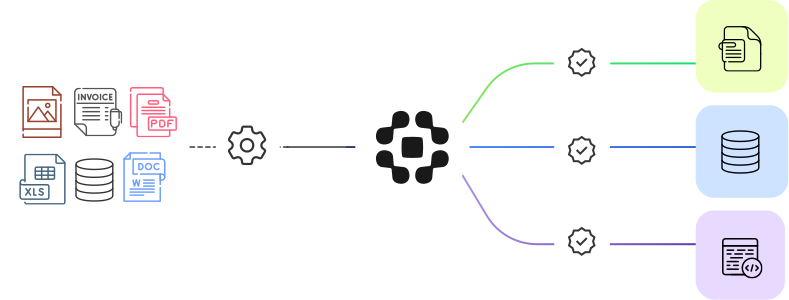
Five capabilities.
One execution engine.
-
Draw reviews at scale
Packages ingested, classified, policy-evaluated, delivered as finished reviews
-
Parallel underwriting
Credit, collateral, cash flow, guarantor strength analyzed simultaneously
-
Covenant monitoring
Continuous portfolio-wide tracking of covenants and obligations
-
Financial statement spreading
Normalization, ratio calculation, trend analysis across periods
-
Same-day policy deployment
Plain English rules, deployed today


Production Results
Production numbers from real institutions.
Built Technologies Draw Agent reports up to 95% time-on-task reduction and up to 60% faster funding to borrowers.
USE CASES
Every commercial lending workflow. Automated
-
Construction draw reviews
Learn more -
Loan underwriting and credit memos
Learn more -
SBA 7(a) eligibility screening
Learn more -
Covenant monitoring and compliance
Learn more -
Financial statement spreading
Learn more -
Portfolio servicing and exceptions
Learn more -
CRE analysis and administration
Learn more
Industry workflow map
How commercial lending automation works in MightyBot
MightyBot automates commercial lending work by reading complex borrower, collateral, construction, and policy documents, applying lender rules, and producing evidence-backed review packages for underwriting, draws, covenants, and servicing.
Last updated: October 19, 2026| Inputs | Borrower packages, financial statements, budgets, appraisals, inspections, lien waivers, loan policies, covenants, and servicing records. |
|---|---|
| Execution | Agents spread financials, evaluate collateral and policy tests, compare draw evidence, monitor covenant obligations, and escalate exceptions with context. |
| Outputs | Draw-review findings, credit memo inputs, covenant exceptions, servicing tasks, ratios, policy flags, and lender-ready summaries. |
| Audit trail | Each finding retains the source file, clause, amount, calculation, policy rule, confidence signal, and reviewer action. |
| Best for | Commercial lenders that need more throughput from lean credit, construction lending, loan administration, and portfolio teams. |
See draw reviews in production.
Real packages, real policies, institutional scale. Not a demo. In production.
FAQ
Frequently Asked Questions
What can AI agents do in commercial lending?
The document-and-policy work that consumes underwriting and portfolio teams: spreading financials, underwriting files against credit policy, monitoring covenants continuously, and keeping an examiner-ready record of every decision. Human judgment stays on exceptions and approvals.
What makes construction draw reviews so hard to automate?
Extreme document variability from different parties. Photo evidence must match construction schedules. Cross-document validation where every line item must reconcile. Every other tool broke on at least one of these.
How does the Built Technologies integration work?
MightyBot is the execution layer within Built's platform: classification, extraction, photo analysis, policy evaluation. Built handles orchestration and lender experience. Many institutions. The integration is the product.
Can MightyBot enforce our institution's specific policies?
Policies defined in plain English: LTV thresholds, DSCR minimums, documentation requirements. A pre-built policy library ships out of the box. Your credit team modifies directly. No engineering required.
What happens with edge cases?
Edge cases handled. Configurable confidence thresholds per policy. Every routed item includes full analysis context and specific reason for flagging. Reviewers decide in minutes, not hours.
How quickly can we go live?
Weeks, not months. Start with one workflow — typically draw reviews or underwriting. Pre-built policy library covers common commercial lending workflows. No multi-year implementation.
How does MightyBot handle document variability?
Documents arrive in whatever format: PDFs, scans, spreadsheets, digital forms. Classified, extracted, and indexed automatically. A financial statement deep in a loan package gets identified and surfaced. No upstream standardization.