The industry default
Most AI platforms bolt security on after the fact. Shared layers, broad access, and policy promises instead of structural guarantees.
Why MightyBot
MightyBot is a secure AI agent platform for regulated workflows: SOC 2 Type II certified, with tenant isolation, sensitive-field encryption, scoped agent access, and evidence-linked audit trails. Deployment runs in a secure managed VPC with enterprise authentication, and customer data is never used to train models.
Most AI platforms bolt security on after the fact. Shared layers, broad access, and policy promises instead of structural guarantees.
Multi-tenant isolation, encryption, and scoped access controls are part of the core architecture. They are not optional add-ons.
Does the architecture enforce tenant isolation, encryption, scoped access, and auditability by design, or does it only document what should happen?
In MightyBot, customer data, policies, and execution contexts remain isolated by design. Your data and policies are yours alone.
| Control | What it means here |
|---|---|
| SOC 2 Type II | Audited controls cover data storage, processing, access controls, encryption practices, incident response, and change management. SOC 2 reports are available under NDA. |
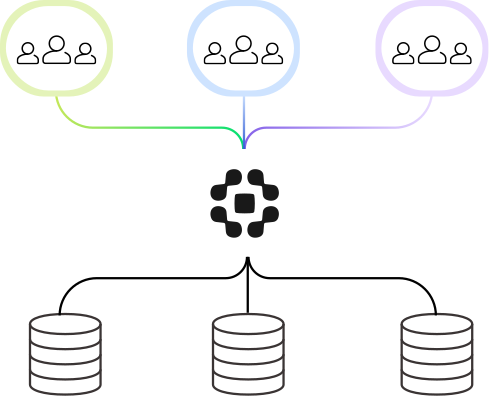
| Tenant isolation | Customer data, policies, and execution contexts remain isolated by design, with no shared data layer between tenants. |
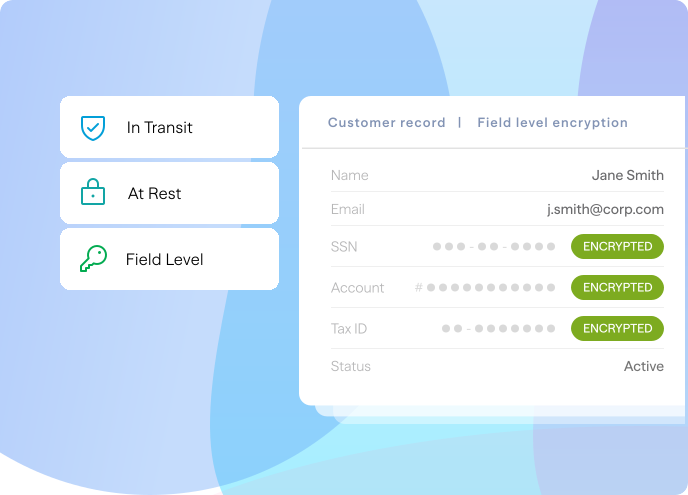
| Sensitive-field encryption at rest and in transit | TLS 1.2+ protects connections, AES-256 protects data at rest, and designated sensitive fields are encrypted independently. |
| Scoped agent credentials | OAuth2 uses scoped permissions, JWT uses scoped claims, and API keys are tenant-scoped, rotatable, and usage logged. |
| Managed VPC deployment | Secure managed VPC deployment uses private network segments and segmented processing tiers for internal services. |
| No model training on customer data | Customer data is processed only for the contracted service scope and is not used to train shared models. |
| Evidence-linked audit trails | Agent workflows preserve evidence-linked audit trails. See AI agent compliance for the audit-trail hand-off. Every API call has a full audit trail. |
Type I confirms controls exist at a point in time. Type II confirms those controls have been operating effectively over an extended audit period. MightyBot holds Type II certification.
The audit covers the entire platform: data storage, processing pipelines, access controls, encryption practices, incident response, change management. Not a subset. The whole stack.
Audit reports available under NDA.
Each customer's data resides in logically separated storage with independent access controls. Agent execution occurs within isolated compute contexts. No shared data layer between tenants.
One customer's documents, policies, and decision records are architecturally inaccessible to another customer's agents or users. This isolation extends to the search layer: per-workflow repositories scope results to the authenticated tenant's data.
Your data and policies are yours alone. Architecturally guaranteed.
Scoped permissions, encrypted tokens. For connecting MightyBot to your enterprise systems with full auditability.
Signed tokens with short expiration and scoped claims. Internal service communication authenticated at every hop.
Scoped to tenants, rotatable, usage logged. Full audit trail on every API call. Rotation without service interruption.
Role-based access control granular to the workflow, document, and field level. See non-human identity context for agent credentials.
Your data is yours. Customer data is not used for training models, not shared with other customers, and not used outside the contracted service scope. Your policies, rules, and workflows remain your property. It is in our terms.
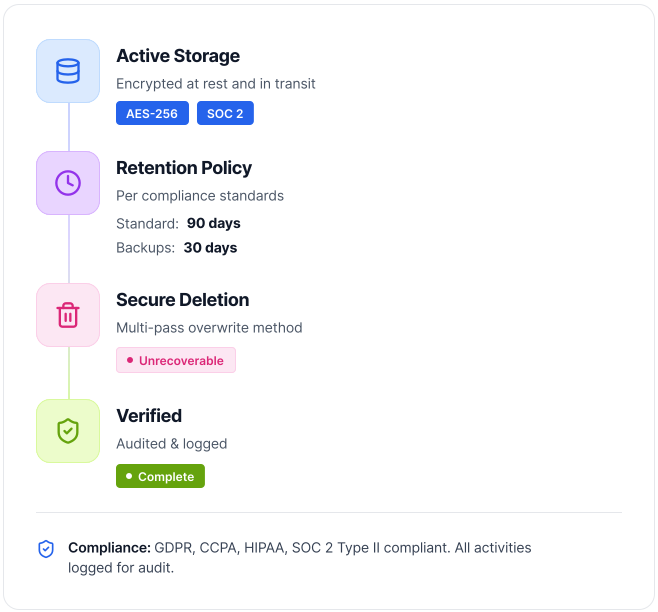
Retention periods are configurable per data type. When periods expire, data is archived to customer-controlled storage or securely deleted. Your choice. These controls support regulated workflows in financial services.
Explore the stack
Which use case fits you
These are the workflows MightyBot runs in production today, each with a buyer's guide, regulator references and the evidence trail examiners ask for.
FAQ
Constrain what the agent can touch (scoped credentials, tenant isolation), constrain what it can decide (policy-gated actions with human review thresholds), and record everything (evidence-linked audit trails). Security reviews then examine controls and records rather than promises.
A SOC 2 Type II report means an independent auditor tested the platform's security controls over a period of time, not just their design on paper. For an AI agent platform it covers the controls around data handling, access, and change management that agent workflows depend on.
Yes. MightyBot is SOC 2 Type II certified, uses tenant isolation, encrypts data at rest and in transit, supports secure managed VPC deployment, and keeps customer data out of shared model training.
Customer data resides in logically separated storage with independent access controls and isolated compute. There is no shared data layer between tenants. Isolation is enforced at the infrastructure level.
Yes. TLS 1.2+ in transit, AES-256 at rest, and field-level encryption for designated sensitive values with granular access controls.
The standard model is a secure managed VPC deployment. If you have specific deployment constraints, MightyBot can review those requirements with your team.
No. Customer data is processed only for the contracted service scope. It is not used to train shared models and is not shared with other customers.
No. The platform is model-neutral: execution style is chosen per task, whether that is parallel execution, step-by-step reasoning, or a planned sequence. Customer data is never used to train shared models regardless of which model runs a task.
Credentials are encrypted at rest, access is restricted to the components that need them, usage is logged, and rotation can occur without service interruption.
Last reviewed: October 21, 2026