
DeadlineShield Review exposure
Reg E Dispute Deadline Enforcement ← Agents Directory

Every missed Day-10 credit starts as a reminder someone could ignore.

DeadlineShield turns Reg E, Reg Z, card network, and ACH dispute clocks into enforcement gates. If the required investigation, provisional credit, notice, or determination is missing, the case blocks or escalates with a complete audit trail.

Runs beside Fiserv, FIS, Jack Henry, FINBOA, Quavo, ServiceNow, or spreadsheets. No core conversion required for the 30-day design partner review.

Find missed-clock exposure
$175M Cash App order tied to fraud and dispute failures
10 days Reg E investigation or provisional credit gate
8,600+ US banks and credit unions with Reg E exposure
30 days Read-only design partner exposure review

What It Does

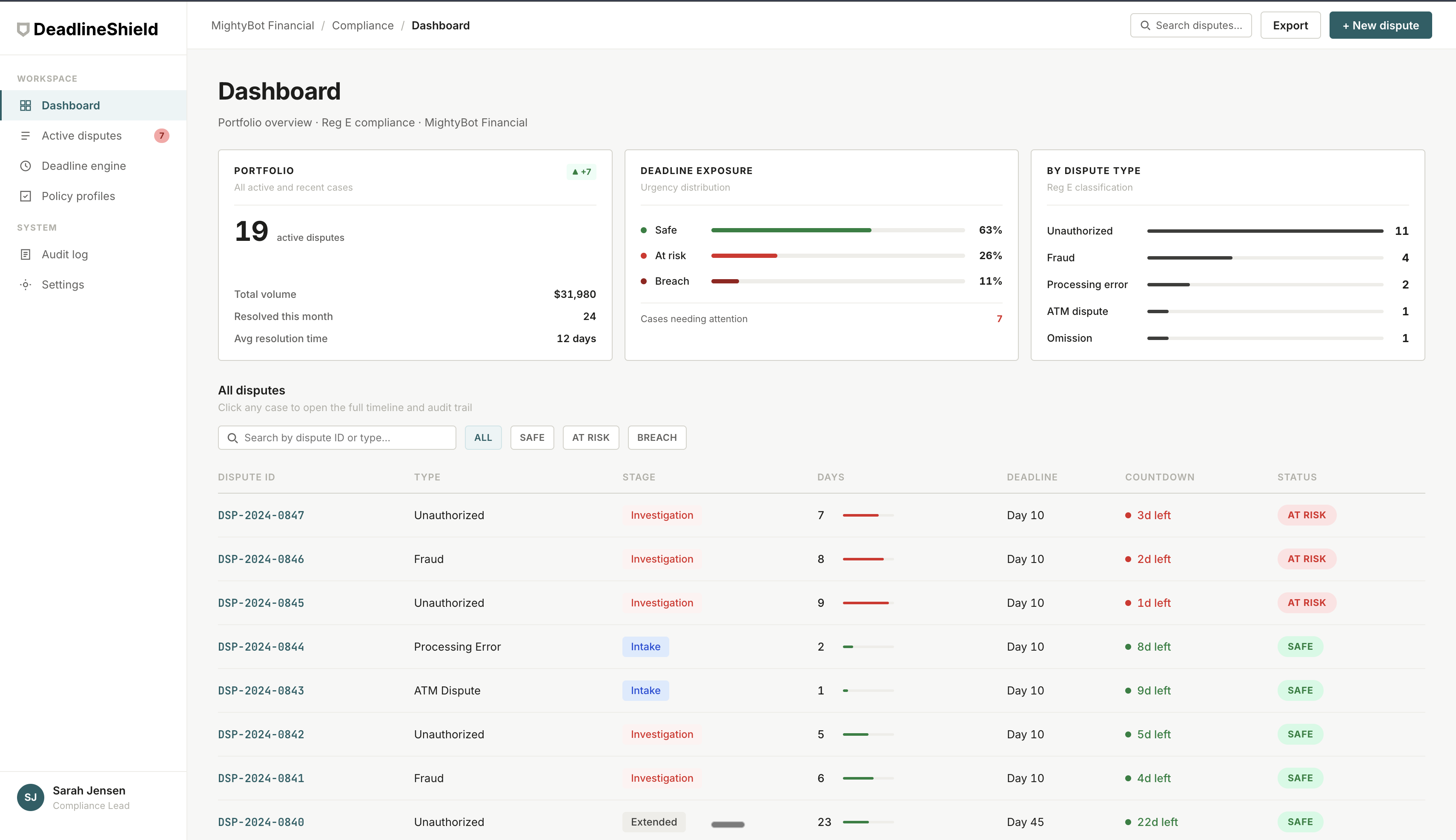
DeadlineShield gives your dispute team a control layer for the clocks that create exam exposure: investigation, provisional credit, notice, determination, reversal, card network response, and ACH timing. It tracks Reg E dispute timeframes, provisional credit deadlines, ACH dispute workflows, card dispute management, and issuer-side chargeback response clocks. Instead of sending alerts, it creates enforcement gates with owner, action, timestamp, citation, and escalation history for every open dispute.

Actions, not intentions

The Cash App order made the risk concrete: consumers were not always investigated, refunded, or provisionally credited when required. DeadlineShield is built around the control examiners actually test: did the required action happen before the clock expired, and can you prove it without reconstructing the case by hand?

DeadlineShield dashboard showing Reg E dispute deadline gates

How It Works

DeadlineShield dispute intake starts every clock workflow
01

Dispute intake starts every clock

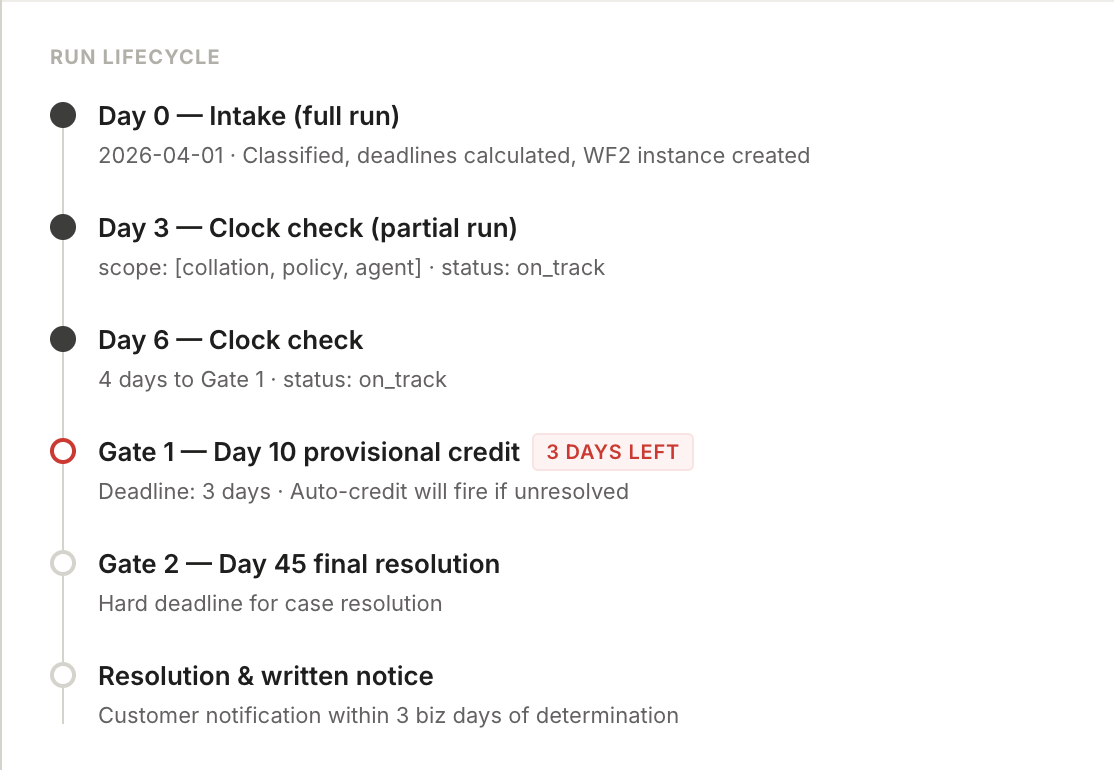
When a dispute is opened, DeadlineShield calculates every applicable clock: Reg E investigation, provisional credit, Reg Z acknowledgment and resolution, card network response, and ACH timing.

DeadlineShield day-10 gate verifies the action workflow
02

Day-10 gate verifies the action

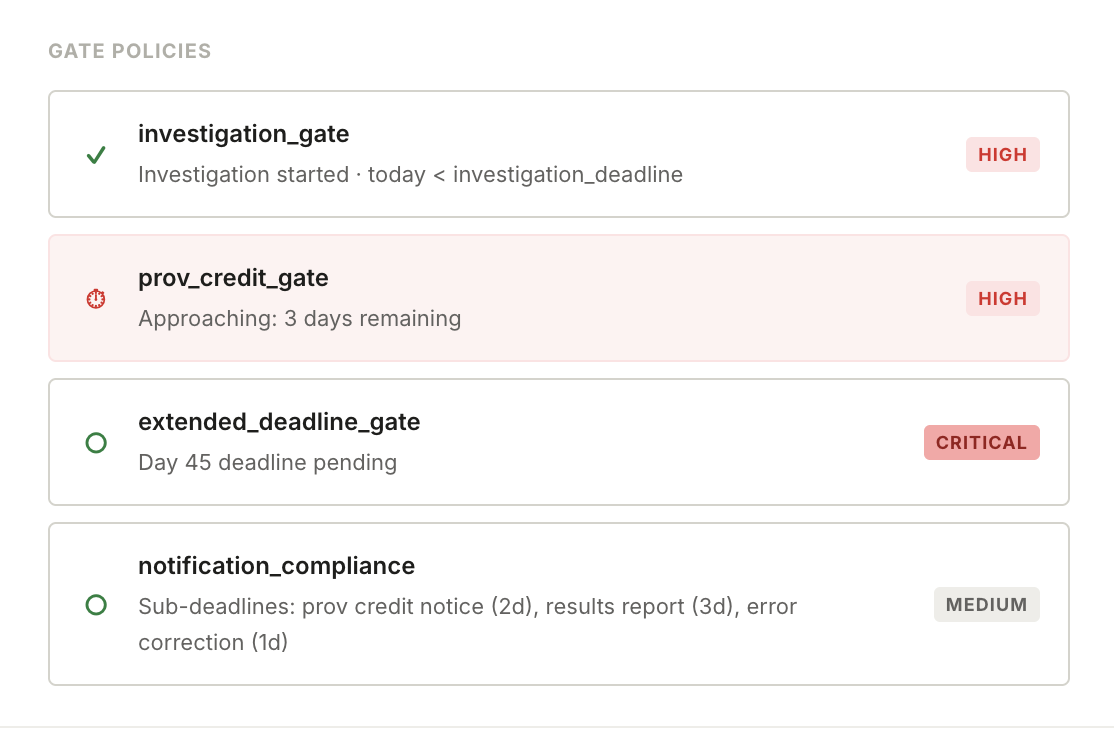
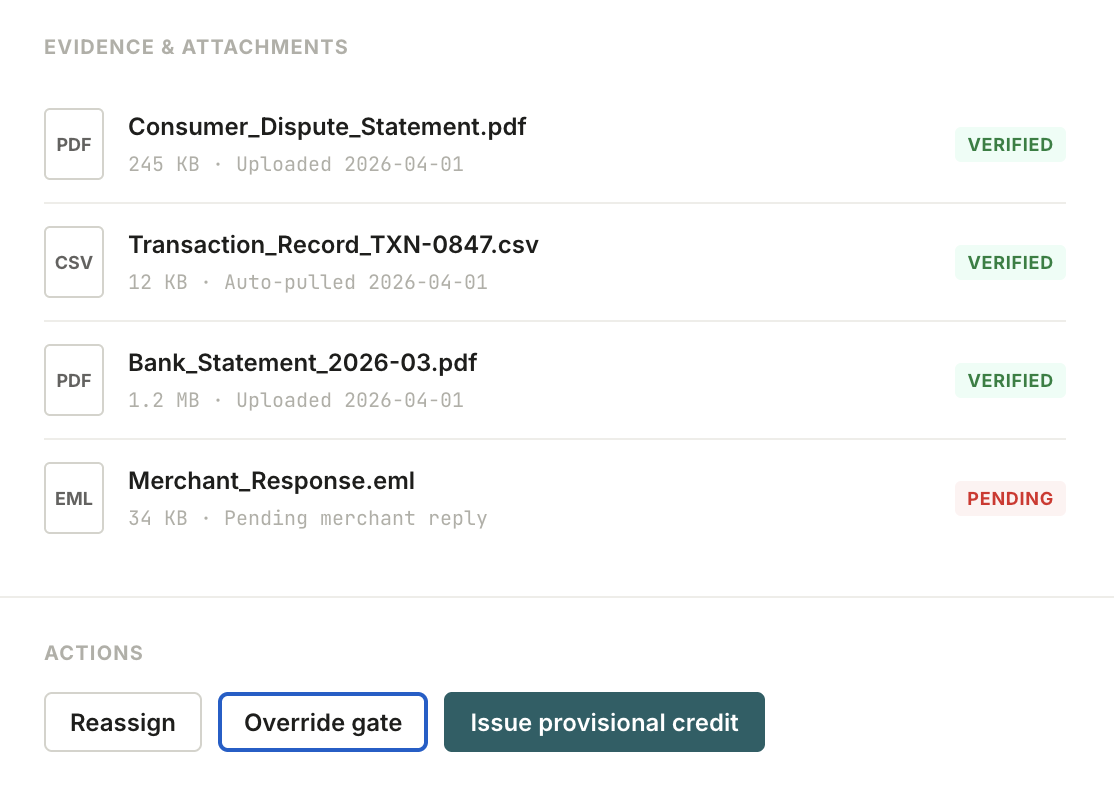
At the Reg E gate, the system verifies that the investigation is complete or the provisional credit action is confirmed. If neither is true, the case blocks or escalates to a named owner.

DeadlineShield extension and notice gates follow workflow
03

Extension and notice gates follow

If the case extends, DeadlineShield enforces the 45/90-day determination clock, consumer notice obligations, provisional credit reversal notice, and network response windows.

DeadlineShield audit trail exists from day zero workflow
04

Audit trail exists from day zero

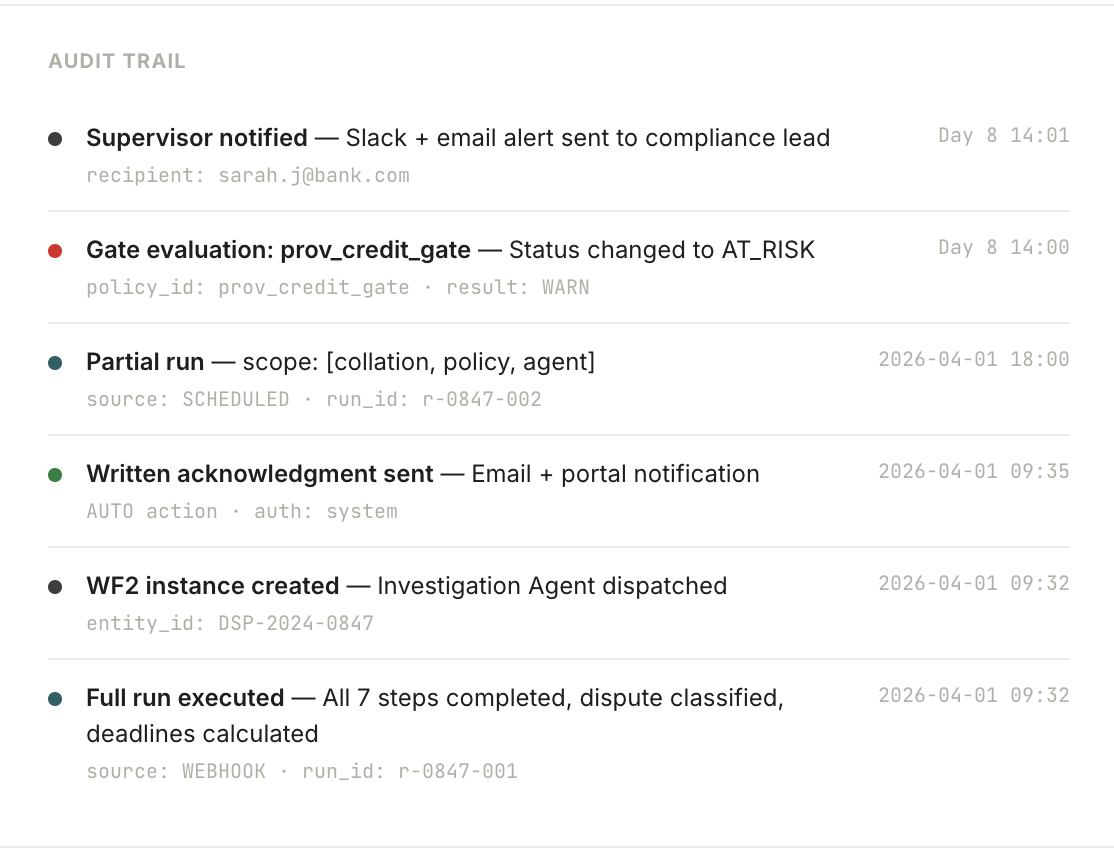
Every gate creation, trigger, escalation, override, action, timestamp, actor, and regulatory citation is logged as the work happens. No spreadsheet reconstruction before an exam.

Reg E Deadline Software

What are Reg E dispute timeframes?

Reg E, Reg Z, ACH, and card disputes create overlapping clocks. DeadlineShield does not treat them as reminders. It turns each required action into a gate with an owner, due date, evidence requirement, escalation path, and audit record.

Clock Required action DeadlineShield gate
Reg E error-resolution gate Complete investigation or provide provisional credit when the investigation is not complete in the required window. Verifies investigation status, credit action, owner, due date, and escalation before the case can drift.
Extended investigation gate Track extension conditions, final determination timing, consumer notices, and credit reversal requirements. Runs each clock separately and records the evidence behind every cleared gate.
Reg Z and card disputes Manage acknowledgement, investigation, response, representment, and consumer communication windows. Keeps non-Reg E clocks visible beside the bank dispute workflow instead of hiding them in notes.
ACH and network timing Route ACH, network, and internal operations deadlines to the correct owner before cutoff. Escalates missing actions and exports a time-stamped audit trail for review.

Tracking the deadline is not the same as meeting it.

Fiserv, FIS, FINBOA, Quavo, ServiceNow, and spreadsheets can all show a deadline. The failure mode is what happens next. Alerts get missed, manual GL steps drift, holiday calendars get miscounted, and the audit trail gets rebuilt after the fact.

The alert lands in the wrong queue

A Day-8 reminder goes to a shared inbox. The analyst is on PTO. The backup has 47 other disputes. Day 11 arrives and the case still has no completed investigation or confirmed credit.

The intent is tracked, but the action is missing

Someone meant to post provisional credit. The workflow note says the extension was requested. Reg E does not ask whether the team intended to act. It asks whether the consumer got the required remedy.

The exam finds the pattern

One missed clock is an error. A portfolio of missed clocks is a control failure. Examiners, state regulators, and plaintiff attorneys can all read the same timeline.

Why It Is Different

Alerts tell people what to do. Gates prove it happened.

Existing dispute platforms optimize workflow. DeadlineShield sits beside them as the compliance-gate layer for required actions and examiner evidence.

Capability
Alert-based tools
DeadlineShield
What happens at a deadline
Email, task, or overdue dashboard status
Gate blocks or escalates until the required action is confirmed
Day-10 provisional credit
Manual step that can be noted but not posted
Required remedy is verified before the case can move forward
Multiple concurrent clocks
Often tracked as a single case due date
Investigation, credit, notice, reversal, network, and ACH clocks run independently
Exam response
Reconstruct the timeline from email, notes, and core records
Export the gate history with actor, timestamp, action, override, and citation

Run a 30-day missed-clock exposure review.

We are opening five design partner slots for banks, credit unions, and fintechs that want to test the gate model against recent dispute data. You get an exposure dashboard, sample audit trails, and a clear view of where reminders are not enough.

FAQ

Frequently Asked Questions

What regulations does DeadlineShield enforce?

DeadlineShield enforces dispute clocks across Reg E, Reg Z, card network rules, and ACH/NACHA timing. The first design partner focus is Reg E because the Day-10 investigation and provisional-credit gate creates the most immediate exam exposure.

What is bank dispute deadline management software?

Bank dispute deadline management software calculates and enforces the required clocks for Reg E, Reg Z, ACH, card, and provisional credit deadlines. DeadlineShield turns each clock into a gate with owner, required action, citation, escalation history, and examiner-ready evidence.

Is DeadlineShield chargeback software for merchants or banks?

DeadlineShield is built for banks, credit unions, fintechs, and card issuers. It focuses on regulated dispute deadlines, Reg E and Reg Z obligations, ACH/card error-resolution workflows, and issuer-side chargeback controls, not ecommerce merchant chargeback recovery.

Does DeadlineShield require changes to our core banking system?

No core conversion is required for the design partner pilot. DeadlineShield can start with a recent dispute export, CSV upload, or API feed. Your team keeps using FIS, Fiserv, Jack Henry, FINBOA, Quavo, ServiceNow, or spreadsheets while DeadlineShield runs the compliance-gate layer beside it.

What happens when a gate fires and the required action hasn't been taken?

The case blocks or escalates to the defined owner: analyst lead, supervisor queue, compliance officer, or operations owner. In the pilot, posting remains in your existing core system; DeadlineShield verifies and records that the required action occurred before the gate clears.

How does DeadlineShield differ from tools like FINBOA or Quavo?

FINBOA and core modules are strong workflow tools. Quavo is strong investigation automation. DeadlineShield is focused on a different layer: deadline enforcement. It does not just show that a case is overdue. It blocks or escalates the required action and creates an examiner-ready gate history.

What does the audit trail include?

Every gate creation, trigger, escalation, action taken, override, resolution, timestamp, user ID, and regulatory citation. The goal is to answer the examiner question directly: what was required, when was it due, who owned it, what happened, and what evidence proves it?

What are Reg E dispute timeframes?

Reg E dispute timeframes depend on the account, transaction type, notice timing, and investigation posture. DeadlineShield is built to calculate the applicable clock, verify whether the required investigation, credit, notice, or determination occurred, and preserve the evidence behind that gate.

What do we get from the 30-day design partner pilot?

A read-only exposure review on your recent dispute data: open clocks, missed or near-missed gates, Day-10 credit exposure, routing gaps, and sample examiner-ready audit trails. No production core changes are required to see whether the gate model fits your operation.