Use Cases
Financial Statement Spreading Automation
What is financial statement spreading?
Financial statement spreading is the process of extracting line items from borrower financials and mapping them into a lender's standard credit schema. MightyBot automates spreading with AI agents: statements in any format are extracted, canonicalized, and checked, with an evidence pointer behind every number.
The Problem
Financial spreading is the foundation of credit analysis: the bottleneck.
Until the spread is complete, no ratio calculated, no loan underwriting
decision made.
Every firm presents statements differently. Manual spreading means an analyst maps
each line item and types each value. Transposition errors are common, mapping
inconsistent across analysts. For commercial lending,
these compound into unreliable analytics.
Format chaos
Every firm, every borrower, every year looks different
Schema drift
Inconsistent categorization compounds across the portfolio
Manual data entry
Transposition errors on every spread
Multi-entity complexity
Consolidation, fiscal year changes, method changes
Downstream dependency
Everything in credit analysis waits on the spread
How MightyBot Executes
-
Line Item Extraction
Any format — PDFs, scans, tax returns, internally prepared. Tables, line items, subtotals identified with character-level precision. Multi-page, multi-year — all in one pass.
-
FRS Canonicalization
Where schema drift dies. The Field Resolution System maps items to the Canonical Field Library. "Cost of Goods Sold," "Cost of Revenue," and "Direct Costs" resolve to the same item. No analyst interpretation. Deterministic. Every time.
-
Structured Output with Evidence Pointers
Every value linked to source — page, table, cell. Analysts verify any figure with a click. Auditors trace ratios to source documents.
-
Multi-Period and Multi-Entity Normalization
Multiple years, entities, fiscal year changes — all normalized into consistent time-series. Comparable datasets ready for trend analysis.




Schema drift is structural. FRS canonicalization is the structural solution.
Before vs After
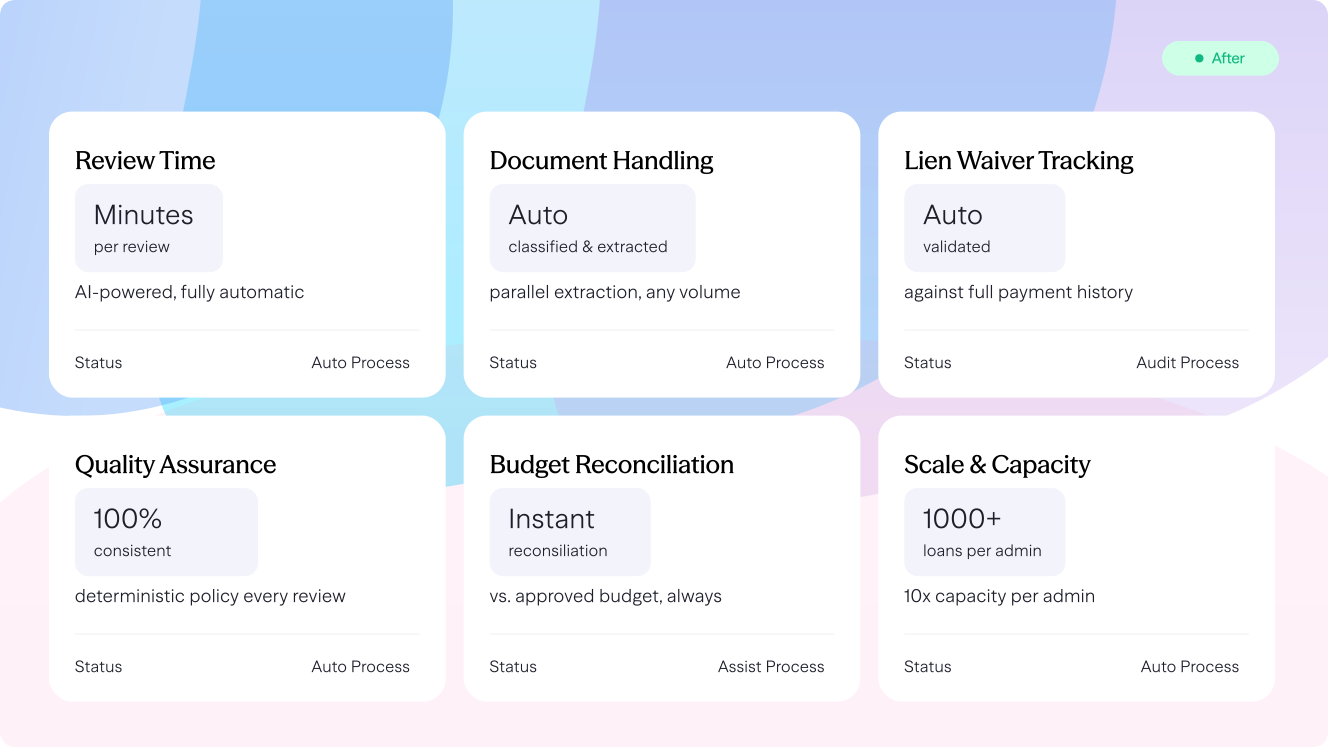
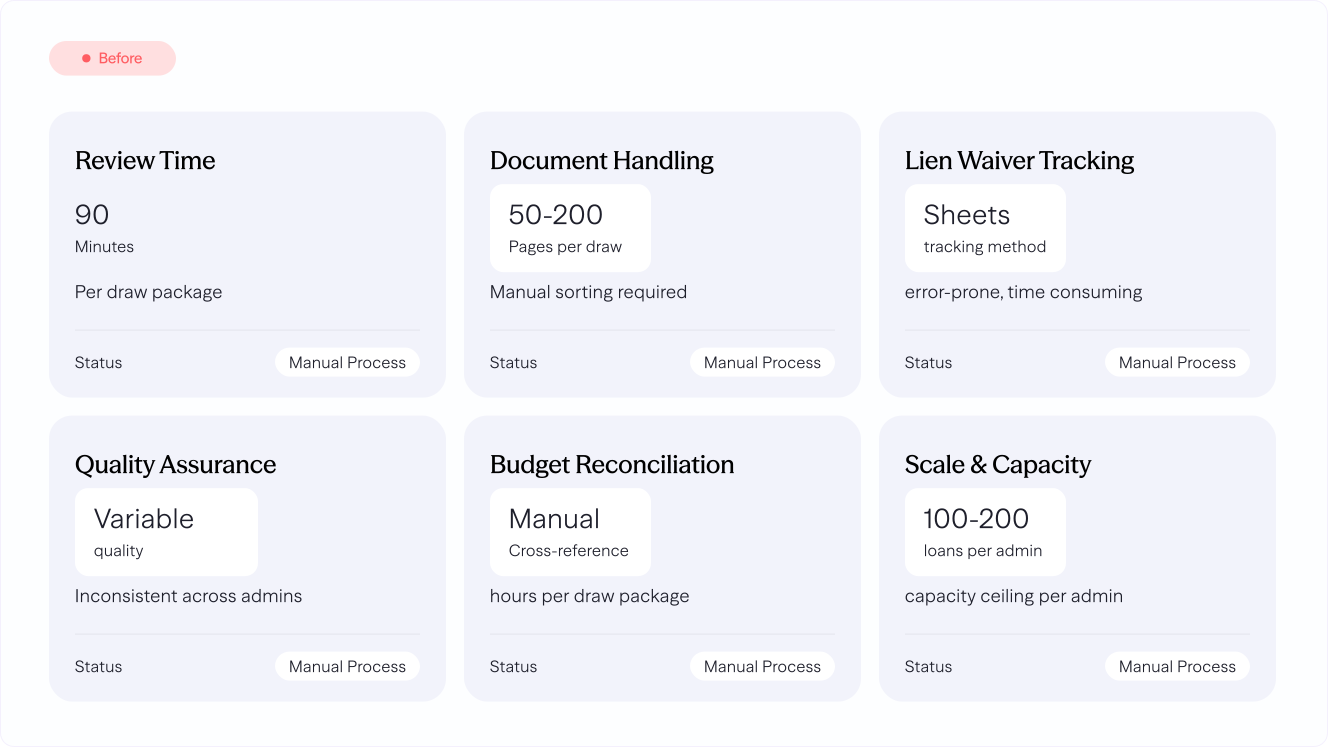
The bottleneck in every credit decision. Eliminated.
Use-case map
How Financial Statement Spreading Automation works in MightyBot
MightyBot automates financial statement spreading by extracting line items from any format, canonicalizing them through FRS, and producing structured credit-ready output.
| Inputs | Financial statements, balance sheets, income statements, cash flow statements, tax returns, schedules, and multi-year borrower packages. |
|---|---|
| Execution | Extracts line items, maps them to canonical fields, reconciles periods and entities, validates balances, and normalizes data for downstream analysis. |
| Outputs | Structured spreads, canonical financial fields, ratio-ready data, validation flags, and source-backed credit inputs. |
| Audit trail | Every normalized line item traces to its source statement, row, period, entity, and mapping rule. |
| Best for | Credit teams where spreading delays every underwriting, covenant, and risk evaluation workflow. |
FAQ
Frequently Asked Questions
What is financial statement spreading?
Financial statement spreading is the line-by-line transfer of a borrower's financial statements into a lender's standardized analysis format so ratios and trends can be compared across borrowers. It is a prerequisite for underwriting, annual reviews, and covenant monitoring.
How does financial spreading automation work?
AI agents classify each incoming document, extract the line items, map them to the lender's spreading schema, and flag anything out of balance for review. In MightyBot, every mapped value keeps a pointer to the exact page and cell it came from, so reviewers verify in seconds instead of re-keying.
How does MightyBot handle non-standard line item names?
FRS maps thousands of variations to standardized categories. New variations are resolved using context - position in the statement, relationship to subtotals, and neighboring values. The library grows. Schema drift doesn't.
Can MightyBot spread tax returns?
Personal and business returns - 1040s, 1120s, 1120-S, and 1065s. Line items are mapped to canonical categories so tax and financial statement analysis can be combined for the same borrower.
What happens when extracted data doesn't balance?
Consistency is validated automatically - assets equal liabilities plus equity, and subtotals match their components. Discrepancies are flagged with evidence pointers so the analyst can resolve the source quickly.
Does MightyBot support different accounting bases?
GAAP, tax basis, and cash basis presentations are all supported. FRS maps them according to context and identifies basis from headers, footnotes, and statement structure.
How does spreading integrate with downstream credit analysis?
Spread output feeds directly into ratio calculations, covenant monitoring, and credit memos. When the spread changes, the downstream analysis updates with it. The spread is the foundation.
Can we customize the canonical schema?
Yes. The Canonical Field Library is the base layer, and your institution-specific categories can sit on top of it. Output can map into your current template and chart of accounts.