
CAPE is live.
Every importer with Chapter 99 exposure is calling their broker.
What is CAPE filing software?
CAPE filing software prepares and validates the CAPE Declaration CSVs that US customs brokers upload to CBP's ACE portal to claim duty refunds. It assembles entry data into the required schema, applies the eligibility rules for each refund program, and keeps the reasonable-care audit trail brokers are accountable for.
Duty Reclaim supports customs brokers preparing CAPE Declaration CSVs, IEEPA and Section 301 refund claims, duty drawback review, post-summary correction analysis, and customs compliance audit trails. It creates clean, validated, audit-trailed claims ready to upload through your existing ACE Portal account on day one. No new filing path. No new systems. You keep the client relationship. You keep the contingency.
Built for brokers, not around them
The IEEPA tariff refund wave is here. Every importer with Chapter 99 exposure is already on the phone with their broker. Duty Reclaim turns that volume from a liability into a revenue opportunity: CBP-compliant, reasonable-care-documented, filed through your ACE account under your name.
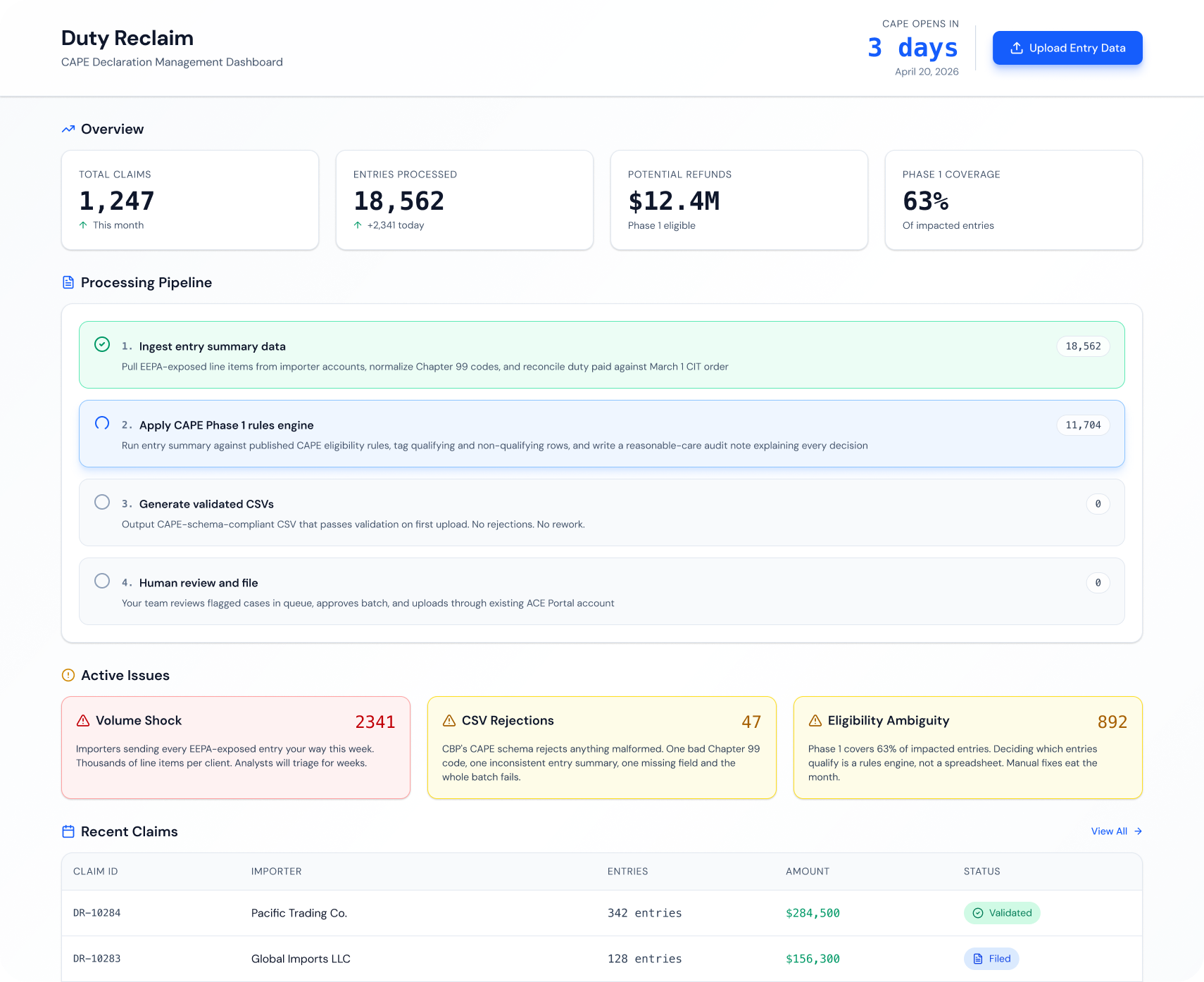
How It Works
- 01
Ingest entry summary data
Connect your TMS or drop in CSV exports. Normalizes Chapter 99 codes and reconciles duty paid against the March 4 CIT order.
- 02
Apply the CAPE Phase 1 rules engine
Runs each entry against published CAPE eligibility rules, tags qualifying and non-qualifying rows, and writes a reasonable-care audit note explaining every decision.
- 03
Generate validated CSVs
Outputs CAPE-schema-compliant CSVs that pass CBP validation on the first upload. No rejections. No rework.
- 04
Human review and file
Your team reviews flagged edge cases in a queue, approves the batch, and uploads through your existing ACE Portal account. Duty Reclaim never touches CBP.
Duty Reclaim is not generic duty drawback software.
It is a CAPE filing automation layer for customs brokers handling a sudden refund queue. Your team keeps the importer relationship and the final ACE upload; Duty Reclaim prepares the validated CSV and the review record.
CAPE filing workflow
| Input | Duty Reclaim checks | Output |
|---|---|---|
| Entry summary data | Normalize entry numbers, importer records, Chapter 99 exposure, and duty-paid fields. | Clean filing candidate list. |
| CAPE eligibility rules | Apply Phase 1 criteria and separate qualifying, excluded, and edge-case entries. | Review queue with reasonable-care notes. |
| Approved filing batch | Validate CSV formatting, schema requirements, and upload readiness before ACE submission. | CAPE Declaration CSV and audit trail. |
How it compares
| Approach | Where it breaks down | Duty Reclaim |
|---|---|---|
| Manual ACE Portal filing | Works for a handful of entries but creates bottlenecks when importers send thousands of lines at once. | Pre-validates batches and keeps the broker in control of the final ACE upload. |
| Generic duty drawback software | Often built for traditional drawback workflows, not urgent CAPE Declaration CSV preparation. | Focuses on CAPE filing automation, IEEPA refund eligibility, and customs broker review queues. |
| Spreadsheet triage | Easy to lose the eligibility rationale, reviewer decision, and reasonable-care record. | Preserves a per-entry decision trail for broker, importer, and CBP review. |
Last updated October 19, 2026.
Official references: CBP ACE Portal CAPE Declarations Quick Reference Guide; U.S. Customs and Border Protection ACE Portal.
The refund wave is already breaking ops teams.
CAPE is live. Every importer with IEEPA exposure is sending you their entry summary files right now. Your team was already at capacity. Each filing must be validated against CBP's schema, eligibility rules applied correctly, and a reasonable-care audit trail documented. Miss any of that and the whole batch bounces.
Inbox overflow, today
Every importer with IEEPA exposure is forwarding entry summaries this morning. Thousands of line items arriving faster than your ops team can triage.
The first batches are already bouncing
CBP's CAPE schema is rejecting malformed rows. One bad Chapter 99 code or one inconsistent entry summary bounces the whole batch back to your queue.
Your team is stalling on edge cases
Phase 1 covers 63% of impacted entries. Deciding which ones qualify is a rules engine, not a spreadsheet. Every ambiguous call slows the queue.
Related platform pages
How Duty Reclaim connects to the MightyBot platform.
Duty Reclaim applies the same data engine, policy engine, document processing, and ROI model to customs filing workflows.
CAPE is live. 5 design partner slots open. Start filing cleanly this week.
FAQ
Frequently Asked Questions
Which entries can be filed through CAPE now?
CBP launched CAPE on April 20, 2026 and is expanding it in phases. Its current trade notice says CAPE processes most entries that are unliquidated or up to 80 days past liquidation, including entries flagged for reconciliation where the reconciliation entry has not been filed, and warehouse withdrawal entries. Reconciliation summaries, drawback entries and some warehouse entries are not yet accepted. Duty Reclaim validates each file against CBP's CAPE schema before upload, so rejected batches are caught before they reach the portal.
What is CAPE and why does it matter for customs brokers?
CAPE (Consolidated Administration and Processing of Entries) is the CBP tool in the ACE Portal that lets importers and customs brokers file IEEPA duty refund claims by uploading a CSV declaration. Phase 1 covers 63% of impacted entries. The portal opened April 20, 2026. Volume is high and CBP's schema validation means any malformed CSV comes back rejected.
Does Duty Reclaim integrate with our TMS?
Yes. Duty Reclaim connects to your TMS via API or accepts CSV exports directly. It normalizes Chapter 99 codes and reconciles duty paid against the CIT order before generating output CSVs.
What happens to entries that don't qualify under Phase 1?
Non-qualifying entries are tagged and excluded from the CAPE CSV, with an audit note explaining the disqualification. They remain in a separate review queue for Phase 2 or other filing options.
Is Duty Reclaim the same as duty drawback software?
Duty Reclaim starts with CAPE Declaration preparation for IEEPA refund claims, but the same rules engine supports duty drawback review, customs refund workflows, post-summary correction analysis, and trade compliance audit evidence. It is narrower than a generic trade compliance suite and more focused than manual drawback spreadsheets.
Who files the claims — us or Duty Reclaim?
You file. Duty Reclaim generates the validated CSVs and surfaces edge cases for your review. Your team uploads through your existing ACE Portal account. The client relationship and contingency fee stay with you.
What does the reasonable-care audit trail include?
Every entry decision includes the eligibility rule applied, the entry data evaluated, and the determination rationale. Sufficient for CBP examination and importer documentation requirements.