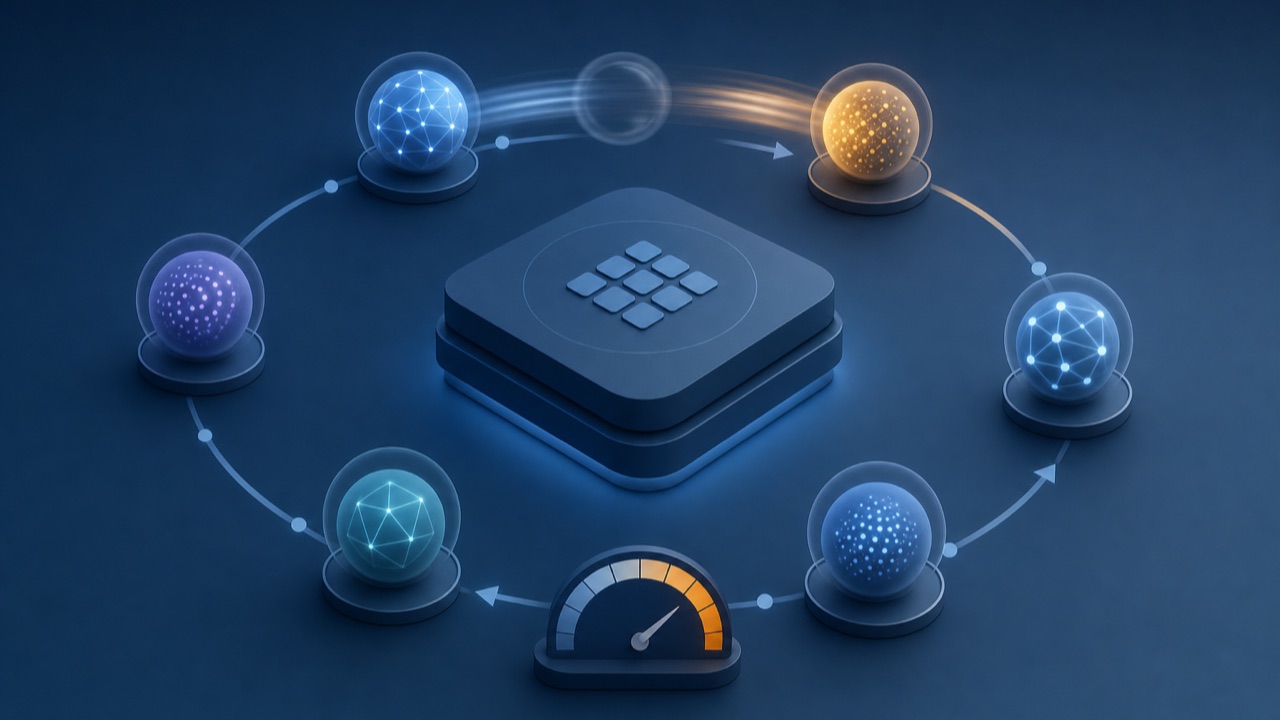
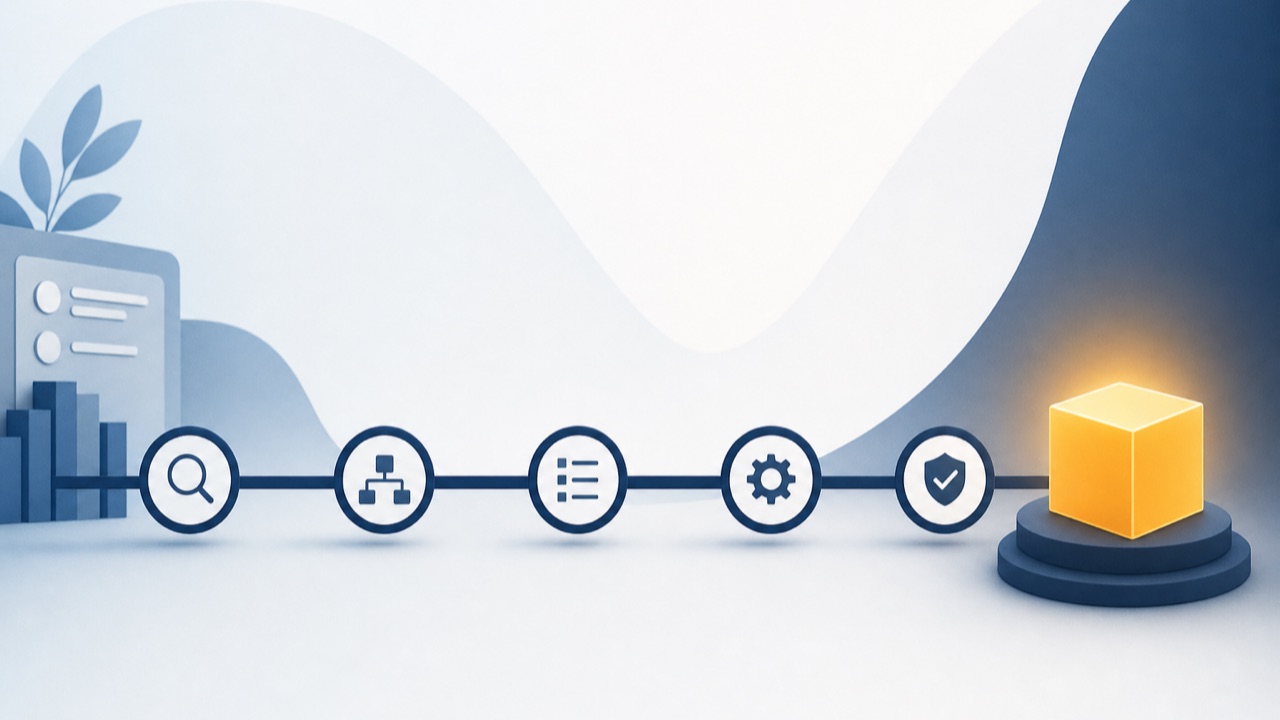
Summary: An agent compiler turns a plain-English description of work, plus the policies and documents that govern it, into a working AI agent: the schemas, the workflow, and the execution plan. It is the alternative to two decade-old paradigms, the drag-and-drop workflow builder and the hand-coded orchestration framework. This post defines the term, explains what a compiler emits, and shows why regulated enterprises are moving this direction.
The two old ways of building an agent
Every agent platform on the market hands you one of two things.
The first is a canvas. You drag steps, draw arrows between them, configure each node, and wire a failure path for every way the process can go wrong. Zapier popularized the model in 2011 and it has been repackaged for agents ever since. The canvas demos beautifully and ages badly: every edge case becomes another branch, every policy change means re-wiring boxes, and the diagram drifts from what actually runs in production. The people who know the rules cannot touch it, because the canvas belongs to engineering.
The second is a framework. LangChain, CrewAI, AutoGen, Semantic Kernel: you write the orchestration in code, own every retry loop, and maintain it forever. Powerful, and a permanent engineering commitment for every workflow you automate.
An agent compiler is the third way. You do not design the workflow at all. You describe the work.
What goes in, what comes out
The inputs to compilation are things your organization already has:
- A description of the agent and the work it owns, in plain English.
- The policies that govern the work: credit standards, review thresholds, compliance rules, written the way your team already writes procedures.
- The documents and examples the work runs on: the loan files, claims packets, statements, and reports that define what real cases look like.
The compiler analyzes those inputs and emits the working system:
- Schemas for the data the workflow extracts and evaluates.
- The workflow itself: steps, dependencies, exception routing, and review gates.
- An execution plan that runs independent steps in parallel, executes deterministic checks as code, and reserves model calls for the steps that need judgment.
There is no diagram at any point. The definition lives in Git as human-readable files, reviewed, versioned, and rolled back like software, and owned like policy.
Why compiled beats drawn at runtime
A drawn flow executes step by step and improvises when reality does not match the diagram. Agents built on reasoning loops improvise even more: try, fail, retry, pay for every attempt. A July 2026 measured study found that growing-context agents replay 3.6x the input tokens of a single compiled pass on the same workload, at 3.5x the cost per evaluation cycle.
A compiled plan behaves like software. Same inputs, same execution path, every time. That determinism is what makes the downstream properties possible: predictable per-case cost, audit trails generated with the decision rather than reconstructed after it, and production accuracy that holds. MightyBot workflows run at 99%+ decision accuracy in production across regulated financial operations.
Why this matters most in regulated work
In a marketing workflow, a drifted diagram is an annoyance. In loan underwriting or claims adjudication, it is a compliance exposure. Regulators ask which rule was in effect, what data it evaluated, and why the decision came out the way it did. A flowchart cannot answer them; a compiled system can, because the policy version, the evidence, and the execution path are all recorded artifacts.
That is also why compilation changes who does the work. When the definition is plain English, the people who know the rules write the rules. Engineering reviews changes the way it reviews code. Nobody babysits a canvas.
Where to see one
MightyBot’s Agent Compiler is documented at /platform/agent-compiler/, including the side-by-side with visual builders. For the economics of compiled execution versus iterative agents, the AI Agent ROI calculator models both paths with measured token data.
The old way is over. Describe the work; the platform compiles the agent.