Covenant Monitoring and Testing ← Agents Directory

Covenant testing that recalculates every ratio under the loan’s own definitions

CovenantShield reads the credit agreement and the borrower’s reporting package, recalculates each covenant with the formula your team approved for that loan, and compares the result with the borrower’s compliance certificate. Each test carries a status, the headroom and its source page, and goes into a review memo written like a credit-file workpaper.
For banks, credit unions and private credit lenders monitoring C&I and commercial real estate loans. Potential breaches, waivers and overrides always go to a person.
Test a borrower package
14 policies Plain-English rules for testing, waivers, review and access
7 document types From credit agreements and amendments to compliance certificates and prior workpapers
10 sections One fixed review memo, from decision box to evidence appendix
Every figure Tied to the document page it came from

The screens a credit team works in

CovenantShield has five working screens: package intake, portfolio overview, loan covenant detail, review queue and run tracker. Three are shown here with fictional loans.

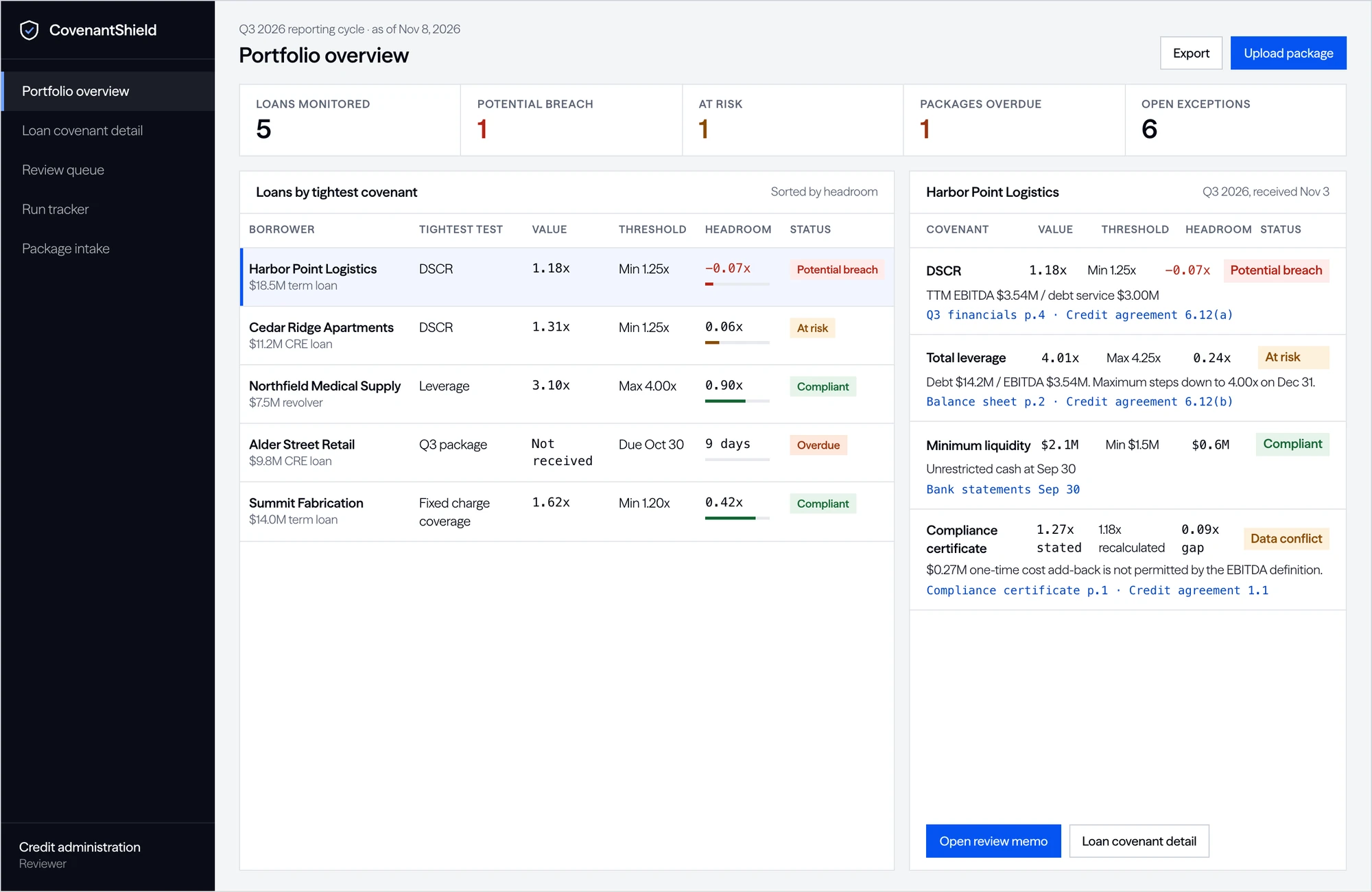
CovenantShield portfolio overview listing five loans by tightest covenant, with the covenant tests for one loan shown beside the list
Portfolio overviewEvery loan ranked by headroom on its tightest covenant. Selecting a loan shows each test with its value, threshold, status and source page.
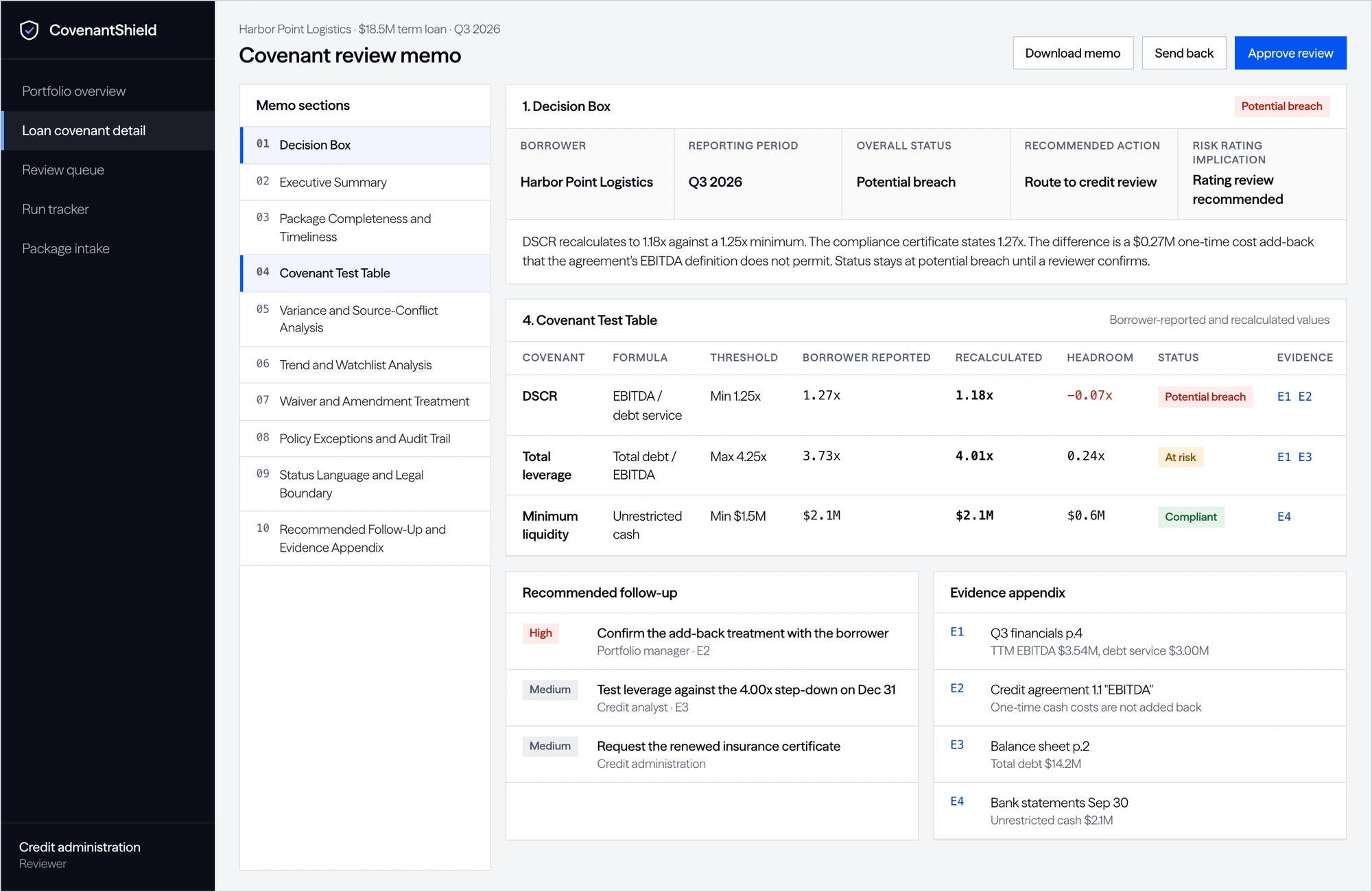
CovenantShield covenant review memo with a decision box, a covenant test table comparing borrower-reported and recalculated values, follow-up actions and an evidence appendix
Covenant review memoTen fixed sections. The test table puts the borrower-reported value next to the recalculated one, with the evidence behind each.
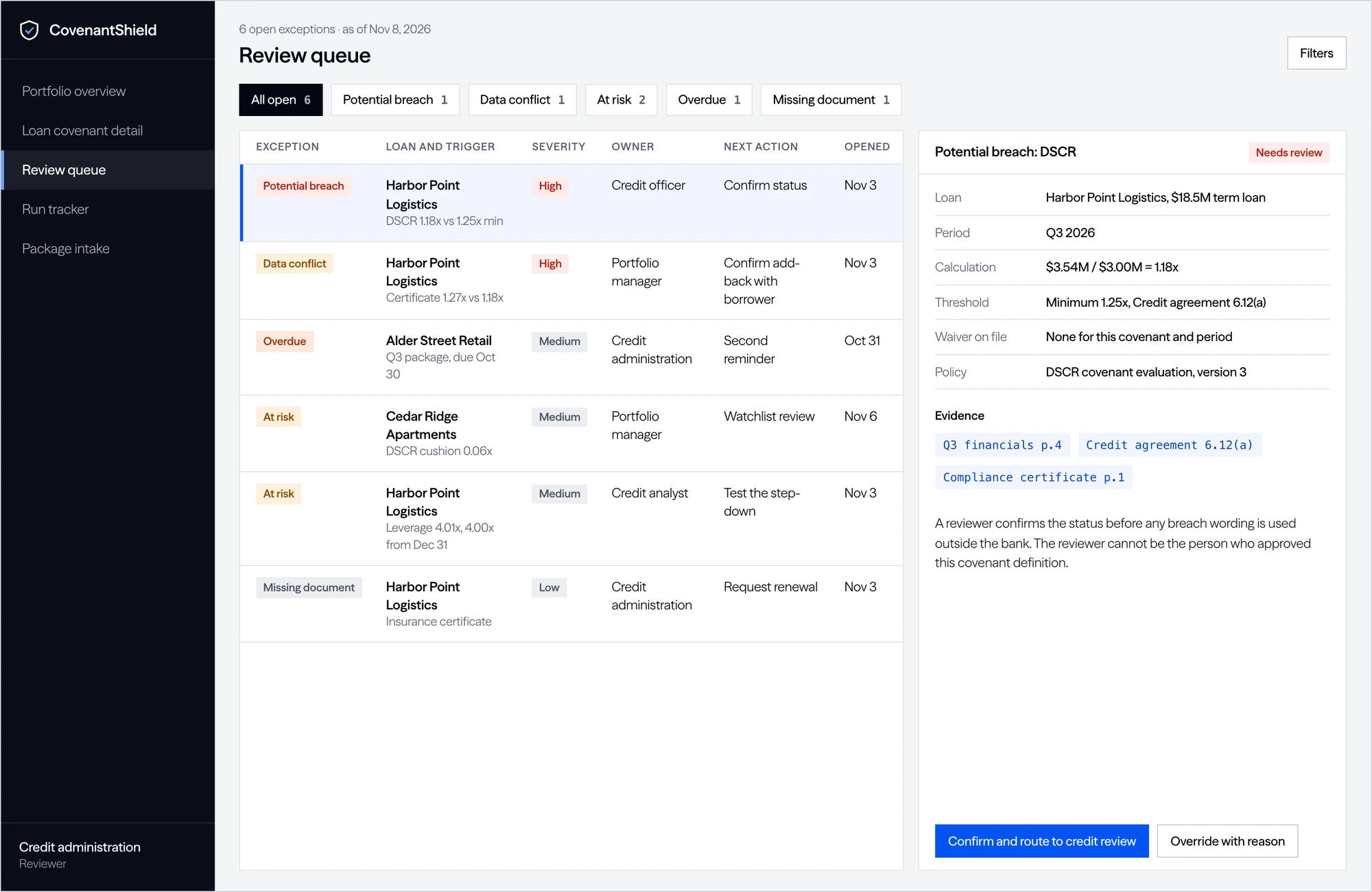
CovenantShield review queue listing six open exceptions with severity, owner and next action, and the detail of a potential breach awaiting reviewer confirmation
Review queueOne exception per loan, covenant, period and trigger, each with a severity, an owner and a next action. A reviewer confirms a potential breach.

What is a covenant monitoring agent?

A covenant monitoring agent tests a borrower’s reporting package against the covenants in its loan agreement. It reads the documents, recalculates each ratio under the agreement’s definitions, measures headroom and flags what needs a credit decision. CovenantShield is that agent. It runs on the MightyBot platform, with your approved covenant definitions and review rules written as plain-English policies.

The certificate is checked against an independent recalculation

A compliance certificate states the borrower’s own ratios. CovenantShield rebuilds each one from the financial statements, using the definitions in the agreement and any amendment in force for the period. When the two numbers differ, the memo shows both and names the cause, such as an add-back the EBITDA definition does not allow.

A failed test is labeled potential breach until a reviewer confirms it. Terms such as event of default, reservation of rights or acceleration need reviewer sign-off before external use. Whether to waive, amend or escalate stays with your credit team.

Covenant review: Harbor Point Logistics, $18.5M term loan Illustrative example
Package
Q3 2026
Received
Nov 3
Result
Potential breach: route to credit review
  • DSCR Potential breach

    TTM EBITDA $3.54M / debt service $3.00M = 1.18x against a 1.25x minimum. Headroom -0.07x.

    Q3 financials p.4 · Credit agreement 6.12(a)
  • Compliance certificate Data conflict

    Certificate states DSCR 1.27x; recalculated 1.18x. The difference is a $0.27M one-time cost add-back the agreement’s EBITDA definition does not permit.

    Compliance certificate p.1 · Credit agreement 1.1 "EBITDA"
  • Total leverage At risk

    $14.2M / $3.54M = 4.01x against a 4.25x maximum that steps down to 4.00x on Dec 31. Headroom 0.24x; fails after the step-down.

    Balance sheet p.2 · Credit agreement 6.12(b)
  • Minimum liquidity Compliant

    $2.1M against a $1.5M minimum.

    Bank statements Sep 30
  • Insurance certificate Missing document

    Certificate expired Oct 31. Renewal not on file.

    Reporting schedule item 5
Fictional borrower shown for illustration. Your loan agreements, approved covenant definitions and review rules drive the real test.

How CovenantShield works

  1. 01

    The package comes in under its loan and period

    An analyst enters the borrower, loan and reporting period and uploads the package, up to 75 files. CovenantShield sorts the documents and checks them against the reporting calendar. Each due date is the period end plus the days the agreement allows, followed by any grace period.

    ProducesA sorted package and a due date for every requirement
  2. 02

    Each covenant is tested with its approved formula

    Only definitions an authorized reviewer has approved are used, each with its formula, threshold, cadence and effective dates. When the numerator or denominator has no source evidence, the calculation is blocked and routed for review.

    ProducesA recalculated value for each covenant
  3. 03

    Each result gets one status and a trend check

    Every covenant is marked compliant, at risk, potential breach, waived non-compliance, overdue, missing document, needs review or data conflict. A pass inside the watch buffer is at risk. An adverse change from the prior period, or two at-risk periods in a row, raises a watchlist signal.

    ProducesOne status per covenant, plus watchlist signals
  4. 04

    The memo and exceptions go to a reviewer

    CovenantShield writes the ten-section review memo and opens one exception per borrower, loan, covenant, period and trigger, each with evidence, severity, owner and next action. Potential breaches, waivers, new definitions and overrides always wait for a person.

    ProducesThe review memo and the exception queue
Covenant checks

What does CovenantShield test in each borrower package?

These are the default policies. Your credit team approves every covenant definition before it is used and sets the watch buffers, reporting rules and reviewers.

InputWhat CovenantShield checksOutput
Credit agreement, amendments and waiversCovenant type, formula, threshold, operator, cadence, testing basis and effective dates; a new version whenever a threshold or formula changesApproved covenant definitions with version history
Reporting requirementsDue date as period end plus the agreement’s days, then grace; due soon 14 days ahead by defaultEach requirement marked due soon, due, overdue, received or waived
Financial statements and compliance certificateDSCR, leverage, fixed charge coverage, liquidity and current ratio, and debt to tangible net worth, with only approved adjustmentsReported value, recalculated value, headroom and status
Rent rolls, operating statements and valuationsProperty DSCR, occupancy, LTV and NOI on property-level figures; rent roll dates and valuation ageCRE covenant results, or a data review task
Prior covenant memos and workpapersLow headroom, adverse change from the prior comparable period, and at risk two periods runningWatchlist signal with the trend calculation
Reviewer actionsWaiver scope by covenant, loan and period; a reason code and before and after values on every overrideAudit record of each decision, with the failed result kept under a waiver

The certificate states a ratio. The agreement defines it.

A compliance certificate reflects the borrower’s reading of the credit agreement. Covenant testing means recalculating each ratio under the lender’s reading, for the version of the covenant in force that period, and recording who decided what.

Harbor Point Logistics, DSCR, Q3 2026 (fictional loan)
As the certificate states it
EBITDA, with add-back
$3.81M
Debt service
$3.00M
DSCR 1.27x
Compliant as filed
As the agreement defines it
EBITDA, Section 1.1
$3.54M
Debt service
$3.00M
DSCR 1.18x
Potential breach
The difference One-time cost add-back the EBITDA definition does not allowCompliance certificate p.1 and Credit agreement 1.1 -$0.27M

Both figures stay in the review memo. A reviewer confirms the status before the word breach is used.

  1. 01

    Definitions change after closing

    Thresholds step down, an amendment changes a formula, and a waiver covers one period. A spreadsheet with one formula per loan keeps testing the old version without any warning.

  2. 02

    Certificates get copied as filed

    When the borrower’s ratio is copied into the file, an add-back the agreement does not allow goes with it. The difference only appears when someone rebuilds the number from the statements.

  3. 03

    Status words carry legal weight

    Calling a failed test a breach or an event of default before credit and counsel have decided puts that word in the file. Status language needs the same control as the numbers.

Why it is different

Covenant tests a reviewer can check line by line

CovenantShield does not replace your loan system or your credit decisions. It prepares each test, the memo and the exceptions, so the reviewer starts from the evidence.

CapabilitySpreadsheet and tickler fileCovenantShield
Covenant definitionsFormulas in cells, edited by whoever opens the fileApproved by an authorized reviewer and versioned with effective dates; the creator cannot be the only approver
Borrower-reported ratiosOften copied from the certificateRecalculated and shown beside the reported value, with the difference explained
Missing inputsEstimated or carried from last periodCalculation blocked until the input has source evidence
Status languageFree textEight set statuses; restricted terms need reviewer sign-off
WaiversFailed result overwrittenWaived non-compliance, scoped to the covenant, loan and period, with the failed result kept
OverridesBuried in file versionsReason code, before and after values, user and time
Commercial real estate agents

Agents for the rest of the CRE loan life cycle

Test one borrower package against its credit agreement.

We are opening design partner slots for banks, credit unions and private credit lenders. Send a credit agreement and a recent borrower package; we return the covenant review memo, test table and exceptions to compare with your own workpaper.

Buyer's guide

How a covenant review cycle runs, from borrower package to reviewed memo

What happens in one covenant review cycle?

The cycle starts before the package arrives. Each reporting requirement in the agreement sets a due date, usually the period end plus a fixed number of days, and a grace period after that. CovenantShield marks a requirement due soon 14 days ahead by default, then due, overdue and, once the grace period passes, an exception for credit administration.

The package arrives under its borrower, loan and period, and the memo records what is missing, late or stale. Each covenant is then recalculated from the statements with the definition approved for that loan and that period, including any step-down or amendment. The borrower’s certified figure sits beside the recalculated one. If an input has no source page, the test does not run; it goes to an analyst.

Each result is labeled, compared with prior periods and written into a review memo with a decision box, a test table and an evidence appendix. The OCC’s Lending and Loan Portfolio Risk Management booklet lists "monitoring the status of required periodic borrower financial statements and loan covenant testing" among loan administration functions, and its Commercial Loans handbook asks how a bank checks "the ongoing accuracy and reliability of borrower certifications." A memo that shows both the certified and recalculated values answers the second question on every test.

Why are potential breach and breach different statuses, and who confirms?

A failed calculation is a fact about numbers. A breach is a conclusion about the loan, and it can lead to default notices, reservation of rights letters or a waiver negotiation. Before reaching it, a reviewer has to confirm the definitions, the inputs, the period and whether a waiver or amendment applies.

CovenantShield keeps those two steps apart. Every failed test is labeled potential breach until a reviewer confirms it. Terms such as breach confirmed, event of default, default notice, reservation of rights, acceleration and waiver accepted can only leave the bank after reviewer sign-off. Each potential breach opens one exception for that borrower, loan, covenant, period and trigger, with evidence, severity, owner and next action, and repeat alerts for the same exception are suppressed unless severity rises.

A waiver does not erase the failure. The OCC booklet counts "Covenant breaches (even if waived)" among financial exceptions a bank should track, and the Rating Credit Risk handbook tells examiners to "be alert for covenants that have been waived or renegotiated." CovenantShield marks a waived failure waived non-compliance and keeps the failed calculation, so the history is there when the next period is tested.

How much of covenant testing should run without a reviewer?

CovenantShield has three modes: audit, assist and automate. In audit and assist modes, a person reviews the results before a status is published. In automate mode, a compliant result can close on its own when every input meets its confidence threshold and no review gate fired, and the reasons are logged.

Every new policy starts in audit or assist mode. Moving to automate mode needs at least a 99 percent pass rate on a backtest of clean historical cases and a reviewer override rate no higher than 2 percent over the last 50 comparable cases. Promoting a policy needs approval from both the policy owner and a workflow administrator.

Some decisions stay with a person in every mode: a new covenant definition, a potential breach, a waiver or amendment, restricted legal language, a low-confidence input that could change a status, a source conflict that could change a status, and any manual override. Each override needs a reason code and records the value before and after.
Questions to ask before software labels a covenant result

Use these to test any covenant monitoring agent, including ours, on one of your own loans.

  • Who approves a covenant definition?An authorized reviewer should approve each formula, threshold, cadence and effective date, and the person who drafted it should not be the only approver.
  • Does it recalculate or copy the certificate?The reported and recalculated values should sit side by side, with the reason for any difference.
  • What happens when an input has no source?The test should stop and go to an analyst. An estimate or last period’s figure should never fill the gap silently.
  • Which words can it use on its own?Breach, event of default and similar terms should need reviewer sign-off. Software should report a potential breach.
  • Is the failed result kept under a waiver?A waiver should change the status for the covenant, loan and period it covers and leave the failed calculation in the record.
  • What evidence moves a policy to automation?Ask for the backtest pass rate and the reviewer override rate that a policy must meet, and who approves the change.

Who does what in a covenant review cycle

CriterionCovenantShieldAnalyst or portfolio managerCredit reviewer or officer
Covenant definitionsDrafts each definition from the agreement and versions every change.Checks the draft against the agreement.Approves or rejects it before any test uses it.
Package intakeFiles the package under its loan and period and lists missing or late items.Requests missing items from the borrower.Sees overdue items past grace as exceptions.
CalculationRecalculates each covenant and shows the borrower’s figure beside it.Resolves data conflicts and blocked inputs.Reviews the test table in the memo.
StatusAssigns one of eight statuses, with potential breach for any failed test.Works the watchlist and at-risk items.Confirms or rejects each potential breach.
Waivers and amendmentsApplies an approved waiver only to its covenant, loan and period.Prepares the waiver or amendment request.Signs off on every waiver and amendment.
Borrower communicationHolds any draft with restricted terms for review.Drafts routine requests and follow-ups.Approves breach and default language before it is sent.

Sources

Sources and verification

Regulatory references were read in the original documents and last verified September 17, 2026. Production figures come from the named MightyBot deployment.

FAQ

Frequently Asked Questions

What is the difference between a potential breach and a breach?

A potential breach is a test result: the recalculated ratio fails the threshold and no approved waiver covers the period. A breach is a credit and legal conclusion that a reviewer makes after checking the calculation, the definitions and any waiver. CovenantShield labels every failed test potential breach and keeps that label until a reviewer confirms it.

Why recalculate a covenant when the borrower sends a compliance certificate?

The certificate is the borrower’s calculation. Add-backs, debt definitions and the trailing period can be read differently from the agreement, and the difference can move a ratio across its threshold. CovenantShield recalculates each ratio from the financial statements, shows the reported and recalculated values side by side, and labels a material difference as a data conflict.

Does a waiver change the covenant test result?

No. A waiver changes the status, not the calculation. CovenantShield applies a waiver only to the covenant, loan and period it covers, marks the result waived non-compliance and keeps the failed calculation in the record. An expired waiver is not carried into later periods, and waiver language that is unclear or covers several facilities goes to a reviewer.

Who approves a covenant definition before it is tested?

An authorized credit administration reviewer. A definition cannot go live until its formula, threshold, cadence, effective dates and source evidence are present and the reviewer approves it. The person who created the definition cannot be its only approver, and any later change to a threshold or formula creates a new version with its own effective dates.

Which covenants can CovenantShield test?

Debt service coverage, leverage, fixed charge coverage, liquidity and current ratio, debt to tangible net worth, and CRE operating covenants such as property DSCR, occupancy, LTV and NOI. Each is tested with the formula approved for that loan. It also tracks reporting covenants: what is due, when, and what has arrived.

When can covenant tests run without a reviewer?

New policies start in audit or assist mode, where a person reviews the results. Automate mode needs at least a 99 percent pass rate on a backtest of clean historical cases and a reviewer override rate no higher than 2 percent over the last 50 comparable cases. Even then, only clean compliant results close on their own.

What does the covenant review memo contain?

Ten sections in a fixed order: decision box, executive summary, package completeness and timeliness, covenant test table, variance and source-conflict analysis, trend and watchlist analysis, waiver and amendment treatment, policy exceptions and audit trail, status language and legal boundary, and recommended follow-up with an evidence appendix. Follow-up actions each carry an owner and a priority.

What documents does CovenantShield need?

The loan or credit agreement with its amendments and waivers, and the borrower’s package for the period: compliance certificate, financial statements, reporting package and support schedules. Prior covenant memos and workpapers add the trend history. PDFs, spreadsheets, Word files and scans are accepted, up to 75 files per package.

What does a design partner pilot include?

A read-only run on a set of your loans. You send a credit agreement and a recent borrower package; we return the review memo, the covenant test table and the exceptions to compare with your own workpaper. CovenantShield has been built and run on test and synthetic loan packages, and a pilot is its first run on your loans. MightyBot is in production at over 30 banks and lenders.